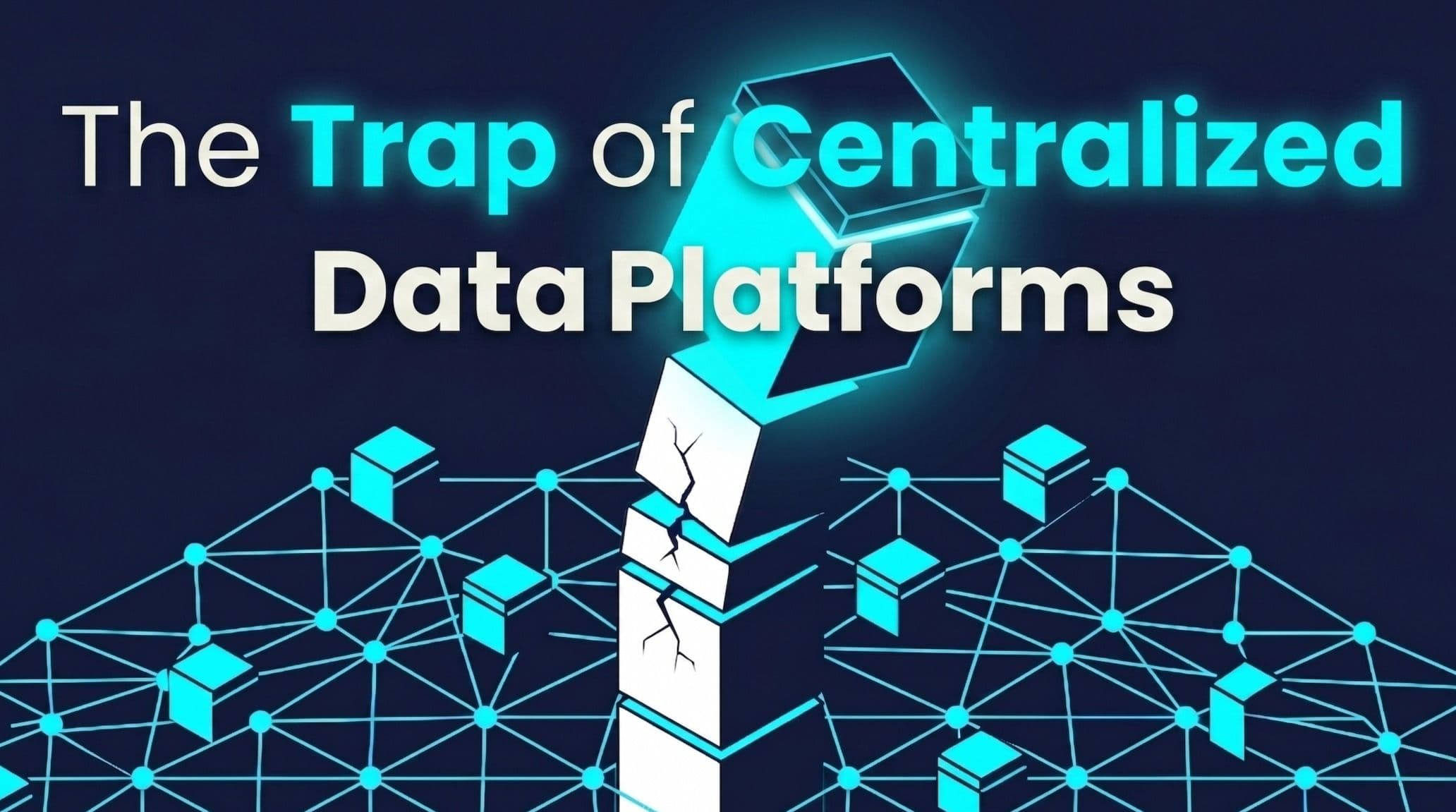
The Trap of Centralized Data Platforms (And How to Escape It)
Sooner or later, the conversation reaches your desk. Your company is sitting on data that partners would pay for, or that could unlock a new collaboration, and someone proposes finally putting it to work. The first practical question sounds harmless: which platform do we list it on?
That question is the trap.
Whatever you choose, you've just handed the fate of a new business line to a company you don't control. Its fees, its rules, its roadmap, and its survival become yours by proxy. The real decision isn't which platform. It's whether your data strategy should depend on a single point of failure at all.
Here are five reasons it shouldn't.
1. Lock-in: you play by their rules, or you don't play
A centralized data platform lets you publish on its terms. It sets the fees, defines the rules, and changes both whenever it likes. Over time you build up listings, a reputation, and integrations; and every one of them becomes a reason you can't leave. The platform ends up capturing the value of a network you helped build, and the day its terms stop working for you is the day you discover how expensive starting over really is.
2. Fragmentation: your data is here, your buyers are there
Now multiply that by every platform in your market. Each one is a separate silo with its own audience. Your data lives on one; a partner who needs it is active on another; neither of you can see across the wall. The perverse result is that more platforms make discovery worse: the market splinters, and you reach a fraction of the demand that actually exists for what you have.
3. Platform risk: if it disappears, so do you
A revenue line built on someone else's infrastructure is only as durable as that infrastructure. Platforms get acquired, pivot, raise prices, or simply shut down; all decisions made in a boardroom that isn't yours. When that happens, your listings, your access, and the business you built on top of them can vanish overnight. This isn't a hypothetical risk. It's the recurring story of every company that ever built on a platform it didn't control.
4. Trust: who vetted the vetters?
Centralized catalogues ask you to trust their judgment about which listings and which counterparties are legitimate; but that judgment is a black box. You can't independently confirm where a dataset came from, whether a provider meets your compliance bar, or whether the party on the other side is who they claim to be. Trust is asserted by the intermediary rather than something you can verify for yourself. In regulated markets, "trust us" is not an answer your compliance team will accept when dealing with GDPR and strict European data sovereignty standards.
5. Borders: the most valuable deals are the ones that stall
The collaborations with the most upside tend to span industries and countries. A manufacturer, a research institute, and a public body, each in a different sector and jurisdiction. That's also exactly where centralized platforms break down. Each sector and country runs its own system with its own governance, and the deal dies at the seam where incompatible platforms and a lack of unified data standards fail to meet.
The Common Thread
Read those five problems again and you'll notice they aren't really five problems. They're one. Every single one traces back to the same root: a company you don't control sitting in the middle, owning discovery and trust.
That's why you can't fix this by switching to a better-behaved platform. A friendlier gatekeeper is still a gatekeeper. The only real fix changes the structure: it removes the middleman from the middle.
A Catalogue No One Owns
This is what a federated, decentralized data catalogue achieves. By utilizing smart contracts to enforce clear, automated business rules, you register your data on shared infrastructure governed by transparent logic that no single operator controls. It's built on common, open standards, so it works across the whole ecosystem rather than inside one walled garden. And discovery is separated from custody: the catalogue helps people find your data without anyone taking possession of it.
In plain terms: an ecosystem instead of a platform.
Here's how that closes each of the five cracks:
- No lock-in. Your listings live on infrastructure no single company owns. You can use any application or interface built on top of it, and you can leave without losing your presence.
- No fragmentation. You publish once, against shared open standards, and you're discoverable across every participant in the ecosystem at the same time.
- No single point of failure. Remove the central operator and you remove the one entity that could ever pull the plug. Resilience is built into the structure, not promised in a contract.
- Provable trust. Transparent rules and verifiable credentials let you check provenance and compliance for yourself, mechanically, instead of taking an intermediary's word for it.
- Cross-border by default. A shared, standards-based catalogue lets different sectors and countries operate in one interoperable space, so the high-value deals that used to stall can actually close.
What it Looks Like in Practice
Picture an automotive manufacturer in Munich that wants to share quality data with a Tier-1 supplier in Milan and a materials research partner in Paris. On the platform model, that means listing on several national systems, re-formatting data for each, trusting each operator's vetting, and hoping all the pieces stay compatible across borders.
On a decentralized catalogue, the manufacturer publishes once. Every partner across Europe can discover it, verify exactly where it came from and who's offering it, and transact. Without any of them, or any outside company, owning the registry they all depend on.
The Real Question
The question was never which platform? It was why a platform at all?
Discovery, trust, and reach don't have to belong to a gatekeeper. They can belong to the ecosystem; to everyone who participates and no one who controls. Before you commit your data strategy to someone else's infrastructure, it's worth asking where, today, it quietly depends on a single point of control that you'd never accept anywhere else in your business.
That's a question worth answering before the next platform decision lands on your desk.